
Leadership in The Catholic Episcopal Church
- Catholic Episcopal Church
- Jul 20, 2025
- 4 min read
Updated: Jul 21, 2025
We base our Church Leadership on "The Way" or The Early New Testament Church
From its very origins, our founders agreed that leadership of The Catholic Episcopal Church would be unlike those church bodies who have evolved to maintain a “Top-Down Hierarchy”.
We believe that we are following the traditions of the earliest New Testament Church, or “The Way”, where no individual member of our body is greater than any other and we have agreed to espouse a Synodal or “Circular Organisational Structure”, where each person, regardless of their ordained or lay status, remains “One Among Equals”.
Our Bishops have agreed that the title of “Archbishop” is now obsolete in our model of leadership. The title assumes that an individual is greater than or more superior in some way, than everyone else, and we have concluded that it has no place in The Catholic Episcopal Church.
So there remain the three ordained titles of Deacon, Priest and Bishop, which have their origins in the New Testament; each with their own role of Service to the Body of Christ under Apostolic Succession.
We have also agreed that there is no longer any need for a single overall Presiding Bishop, but that each of the members of the Council of Presiding Bishops would serve their own particular jurisdiction with autonomy, while sharing a Synodal or Joint-Presidency of the Church, with a revolving Chair at meetings, and a Secretary to maintain records.
“The greatest among you will be your Servant. For those who exalt themselves will be humbled, and those who humble themselves will be exalted.” Matt 23: 11-12

Most Popular Questions about The Catholic Episcopal Church
Our Presiding Bishops


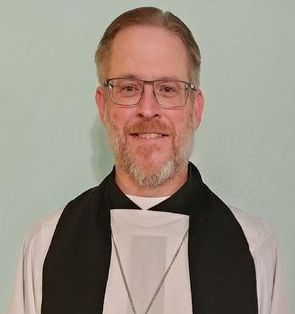


Seamus MacGhille Aindrais, Secretary of The Council of Bishops
Presiding Bishop of Ireland, Britain, Africa, Asia
Ashley Beckham
Presiding Bishop of Canada, North, South America
Ulrich Schwab
Presiding Bishop of Germany, Eastern Europe
Bishops in Early Christianity
A bishop, in the context of the New Testament, is an overseer or leader within the early Christian church. The term "bishop" is derived from the Greek word "episkopos," which means "overseer" or "guardian." This role is closely associated with the responsibilities of shepherding, teaching, and maintaining doctrinal purity within the church community.
The earliest ecclesiastical offices instituted in the church were those of elders and deacons, or rather the reverse, inasmuch the latter office grew almost immediately out of the needs of the Christian community at Jerusalem (Acts 6:1-6). The presbyteral constitution of Jerusalem must have been very old (Acts 11:30) and was distinct from the apostolate (Acts 15:2, 4, 6, 22, 23; Acts 16:4).
As early as 50 A.D. Paul appointed "elders" in every church, with prayer and fasting (Acts 14:23), referring to the Asiatic churches before established. But in writing to the Philippians (Philippians 1:1) he speaks of "bishops" and "deacons."
In the Gentile Christian churches this title evidently had been adopted; and it is only in the Pastoral Epistles that we find the name "presbyters" applied. The name "presbyter" or "elder," familiar to the Jews, signifies their age and place in the church; while the other term "bishop" refers rather to their office. But both evidently have reference to the same persons.
The role of the bishop evolved over time. In the apostolic age, the terms "bishop" and "elder" (presbyter) were often used interchangeably, as seen in Acts 20:17, 28 and Titus 1:5-7.
However, as the church grew, a more distinct hierarchical structure developed, with bishops assuming a more prominent leadership role over multiple congregations within a region.
Priests in Early Christianity:
In the biblical context, priests are individuals set apart to perform sacred duties and act as mediators between God and His people. The role of the priest is central to the religious life of Israel, serving in the Tabernacle and later in the Temple, offering sacrifices, teaching the Law, and maintaining the sanctity of worship.
The New Testament also introduces the idea of the priesthood of all believers, as seen in 1 Peter 2:9 : "But you are a chosen people, a royal priesthood, a holy nation, a people for God’s own possession, to proclaim the virtues of Him who called you out of darkness into His marvelous light."
While it does not establish a formal priesthood akin to the Old Testament, early Christian communities recognized certain leaders, such as elders and overseers, who performed pastoral and liturgical functions. The development of a distinct Christian priesthood evolved over the centuries, drawing on both Jewish and Greco-Roman influences.
Deacons in Early Christianity
The term "deacon or deaconess" is derived from the Greek word "diakonos," which means "servant" or "minister." In the New Testament, deacons are recognized as an official position within the early Christian church, tasked with specific duties to support the ministry and serve the needs of the congregation.
The role of deacons is first mentioned in Acts 6:1-6, where the apostles appoint seven men to assist with the daily distribution of food, allowing them to focus on prayer and the ministry of the word. This passage is often seen as the origin of the diaconate.
"So the Twelve summoned all the disciples and said, 'It is unacceptable for us to neglect the word of God in order to wait on tables. Therefore, brothers, select from among you seven men confirmed to be full of the Spirit and wisdom. We will turn this responsibility over to them and will devote ourselves to prayer and the ministry of the word.'" (Acts 6:2-4).
The office of deacon highlights the importance of service within the Christian community. It underscores the biblical principle that leadership in the church is not about power or prestige but about serving others in humility and love. Deacons exemplify the servant leadership modeled by Jesus Christ, who said, "Whoever wants to become great among you must be your servant" (Matthew 20:26).


Comments